
EPFL PhD Salary 2026: CHF 55,225 Gross, About CHF 3,750 a Month After Tax
October 4, 2026
EPFL publishes exactly what it pays its doctoral students, to the franc. What it does not publish is the number you actually care about: how much of that reaches your bank account in Lausanne once tax, pension and insurance have been taken.
So here is the whole calculation for 2026, line by line, using EPFL's own rates and the canton of Vaud's official tax table - followed by the fees a doctoral student really pays, what Lausanne costs, and how you get admitted in the first place.
First: EPFL hires you as a doctoral assistant
A PhD at EPFL is a job. You are employed as a doctoral assistant at 100%, on one-year contracts that are renewed each year after your annual thesis assessment, for a total of up to six years. EPFL's own rules treat about four years as the normal length of a thesis, and your funding is guaranteed at least until your oral examination.
The salary is the same single scale for every doctoral assistant, whatever the field or the lab. It rises by CHF 1,000 each January, and it comes with five weeks of paid vacation on top of public holidays.
EPFL doctoral salary by year (2026)
| Year of PhD | Gross per year | In rupees (approx.) |
|---|---|---|
| 1st year | CHF 55,225 | ₹66 lakh |
| 2nd year | CHF 56,225 | ₹67 lakh |
| 3rd year | CHF 57,225 | ₹68 lakh |
| 4th year onward | CHF 58,225 | ₹69 lakh |
Valid from 1 January 2026, as published by EPFL Human Resources, and including the 13th month. Converted at about ₹119 to the franc (October 2026).
Would a professor pick you?
The EduSail Abroad PhD Readiness Score rates your profile on the criteria they actually use: free, 2 minutes, no sign-up.
From gross to net: where a first-year salary goes
| Line | Rate | Per year |
|---|---|---|
| Gross salary | - | CHF 55,225 |
| Old-age and disability insurance (AVS/AI/APG) | 5.3% | − CHF 2,927 |
| Unemployment insurance | 1.1% | − CHF 607 |
| Pension fund (PUBLICA), age 22–34 | 5.35% of the insured salary | − about CHF 2,070 |
| Tax at source, canton of Vaud, single | 6.99% | − CHF 3,860 |
| Accident insurance and small cantonal levies | under 1% | − about CHF 250–590 |
| What you keep | about 82% of gross | About CHF 45,000–45,500 |
Our calculation from EPFL's published contribution rates and Vaud's 2026 tax-at-source table for a single person with no children. The tax rate covers federal, cantonal and communal tax together. Your own figure shifts with your age, your commune and your accident-insurance rate.
Why your January payslip looks smaller than the maths
The CHF 55,225 is paid in thirteen instalments, not twelve. A normal month is CHF 4,248 gross, which lands as roughly CHF 3,450–3,500 after deductions. The thirteenth salary arrives at the end of the year, almost all of it with the November pay.
So there are two honest ways to state the take-home figure: about CHF 3,450–3,500 on an ordinary payslip, or about CHF 3,750–3,800 a month when the year-end payment is averaged in. Budget your rent on the first number and your savings on the second.
The fees a doctoral student actually pays
This is where a lot of what you read online is wrong. EPFL and ETH Zurich tripled the semester tuition fee for new international students in autumn 2025, to CHF 2,190. That fee applies to bachelor's and master's students. Doctoral candidates do not pay semester tuition at all.
What a doctoral candidate with an Indian master's degree pays is a CHF 150 registration fee on enrolment and a one-off CHF 1,500 doctoral fee at the end, when registering for the doctoral exam. There is no application fee. Across four years that is CHF 1,650 in total, against about CHF 227,000 of gross salary.
Can you save in Lausanne?
EPFL's own monthly budget for an international student adds up to about CHF 2,100: CHF 900 for housing, CHF 600 for food, and the rest for transport, insurance and everyday costs. That budget uses a student health-insurance tariff. As a salaried doctoral assistant you should plan on EPFL's fuller figure of about CHF 400 a month for health insurance, which takes the total to roughly CHF 2,400.
Against a normal payslip of about CHF 3,450, that leaves around CHF 1,000 a month, plus the thirteenth salary at year end. It is not the fortune the rupee conversion suggests, but it is a real surplus, with no tuition debt behind it.
How admission works
You apply online to one of EPFL's doctoral programs, each of which sets its own fixed deadlines, typically two or three a year, so check the page of the program you want. A committee decides whether you are admissible. Your enrolment then becomes final once you have a thesis director and secured funding, and you have a year to arrange that.
A master's degree is the usual starting point, but EPFL states that candidates with a 4-year or 5-year bachelor's degree may also apply, explaining their education in the statement of objectives. As a general rule the doctoral school does not require GRE, TOEFL or IELTS, though it recommends them for applicants whose first language is not English or French, and an individual program can ask for one. You do not need French to start.
Because the thesis director is the person who hires you, a well-targeted email to a professor whose current work matches yours is as important as the application form.
The permit, and what happens after
EPFL's human resources team prepares your work and residence permit application; allow about three months for visa and permit formalities before your start date. The permit is tied to your thesis.
After the PhD, Swiss law gives graduates of a Swiss university six months from the end of their studies to find a job that matches their qualification. That is shorter than Germany's 18-month window, so start the search before you defend. For how EPFL compares with ETH Zurich and the rest of the country, see what a PhD in Switzerland pays and our complete guide to a fully-funded PhD in Switzerland.
If you're applying from India: what these numbers mean in rupees
| Item | In rupees (approx.) |
|---|---|
| First-year gross | CHF 55,225 ≈ ₹66 lakh a year |
| First-year net | About CHF 45,000 ≈ ₹54 lakh a year, or ₹4.5 lakh a month |
| Ordinary monthly payslip | About CHF 3,450–3,500 ≈ ₹4.1–4.2 lakh |
| UGC JRF / SRF in India, for comparison | ₹37,000 / ₹42,000 a month |
| Total fees over the PhD | CHF 1,650 ≈ ₹2 lakh, paid once, not per semester |
| Living costs in Lausanne | About CHF 2,400 a month ≈ ₹2.9 lakh |
Converted at about ₹119 to the franc (October 2026). Read the rupee figures next to the Lausanne cost of living, not on their own.
EduSail Abroad specializes in exactly one thing: getting Indian students into fully-funded PhD positions abroad. For EPFL, that means choosing the right doctoral program and deadline, and reaching thesis directors who have funding for a new student.
A merit-based commitment fee - ₹15,000 to ₹25,000 plus GST, set by your eligibility score - and a success fee only after your funded offer. That's the model.
The one-line takeaway
An EPFL PhD pays CHF 55,225 gross in the first year and about CHF 45,000 after tax and social contributions, with no semester tuition and only CHF 1,650 in one-off fees - enough to live in Lausanne and still save.
Frequently asked questions
What is the EPFL PhD salary in 2026?
From 1 January 2026 an EPFL doctoral assistant earns CHF 55,225 gross in the first year, including the 13th month. It rises by CHF 1,000 a year to CHF 56,225, CHF 57,225, and CHF 58,225 from the fourth year.
What is the EPFL PhD salary after tax?
For a single first-year doctoral assistant living in the canton of Vaud, about CHF 45,000–45,500 a year remains after tax at source (6.99% in 2026), pension and social insurance. That is roughly CHF 3,450–3,500 on a normal monthly payslip, or about CHF 3,750–3,800 a month once the 13th salary is averaged in.
Do PhD students at EPFL pay tuition fees?
No. The CHF 2,190-a-semester fee introduced for international students in 2025 applies to bachelor's and master's students only. Doctoral candidates pay a registration fee of CHF 150 (with a foreign master's degree) and a one-off CHF 1,500 doctoral fee at the end of their studies. There is no application fee.
Is the EPFL salary paid in 12 or 13 months?
Thirteen. The annual figure includes a 13th salary, most of which is paid with the November salary. A normal month in the first year is therefore CHF 4,248 gross, not CHF 4,600.
Do I need GRE or IELTS for a PhD at EPFL?
As a general rule, no. EPFL's doctoral school does not require GRE, TOEFL or IELTS, though it recommends them for applicants whose first language is not English or French, and an individual doctoral program may ask for one. Check the page of the program you are applying to.
Can I apply to EPFL for a PhD with a 4-year bachelor's degree?
Yes, you can apply. EPFL says doctoral studies usually begin after a master's degree, but candidates with a 4-year or 5-year bachelor's degree may also apply and should explain the specifics of their education in the statement of objectives.
Can EduSail Abroad help me apply to EPFL?
Yes. We match your research profile to the right EPFL doctoral program and thesis directors, draft the statement of objectives and outreach email with you, and prepare you for the interview and permit steps. Start with our free PhD Readiness Score to see where your profile stands.
Related Articles
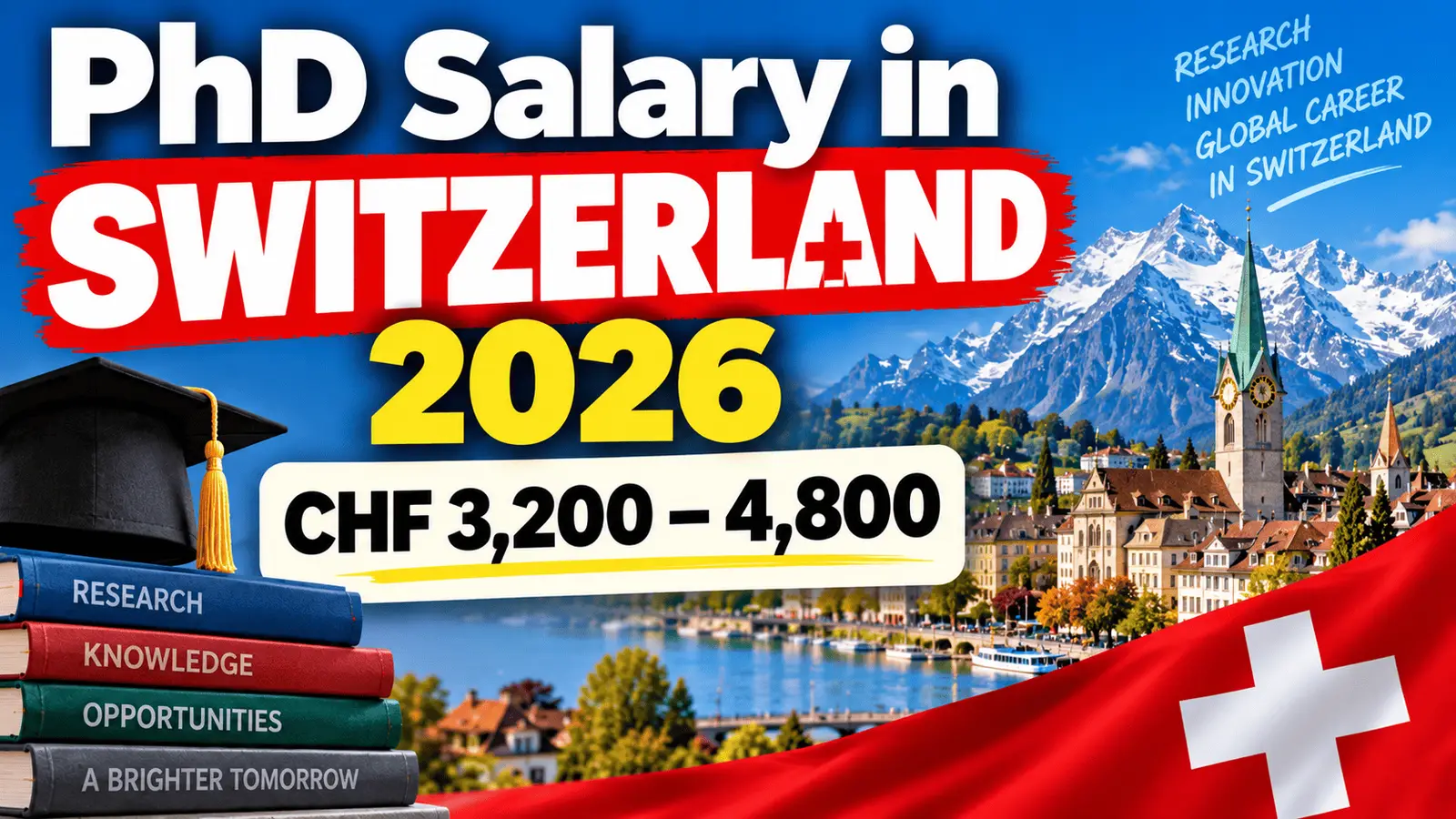
Switzerland doesn't advertise "funded" PhDs because it doesn't need to - every doctoral position there is already a paid job. Here's what that job actually pays in 2026, and why the tripled international tuition fee at ETH Zurich and EPFL does not apply to PhD students.
Understand the critical differences between F-1 and H1B visas and why the F-1 pathway is the most stable and strategic choice for your future in the US.
Students come back describing changes that have nothing to do with the degree. Here are the ones we hear most often.